
Say what the evidence can support.
Define the claim. Define its scope. Hold the evidence. Explain the limitation.
Environmental claims can appear in product copy, packaging, labels, imagery, reports, social posts and brand names. Ecowiser helps brands organise evidence, find gaps and replace broad statements with clearer, supportable language. This page provides general information, not legal advice.
Reviewed August 2026 against current official sources.
Prepared by Ecowiser’s content and evidence team. Jurisdiction summaries link to the official EU, UK, US, India and France sources used. Rules can change and specialist advice may be required for a particular claim or campaign.
Match the evidence to the wording and market.
Recyclable, recycled-content and carbon-related claims create different risks. The matrix shows the type of source and nearby qualification usually needed before a brand decides whether specialist review is required.
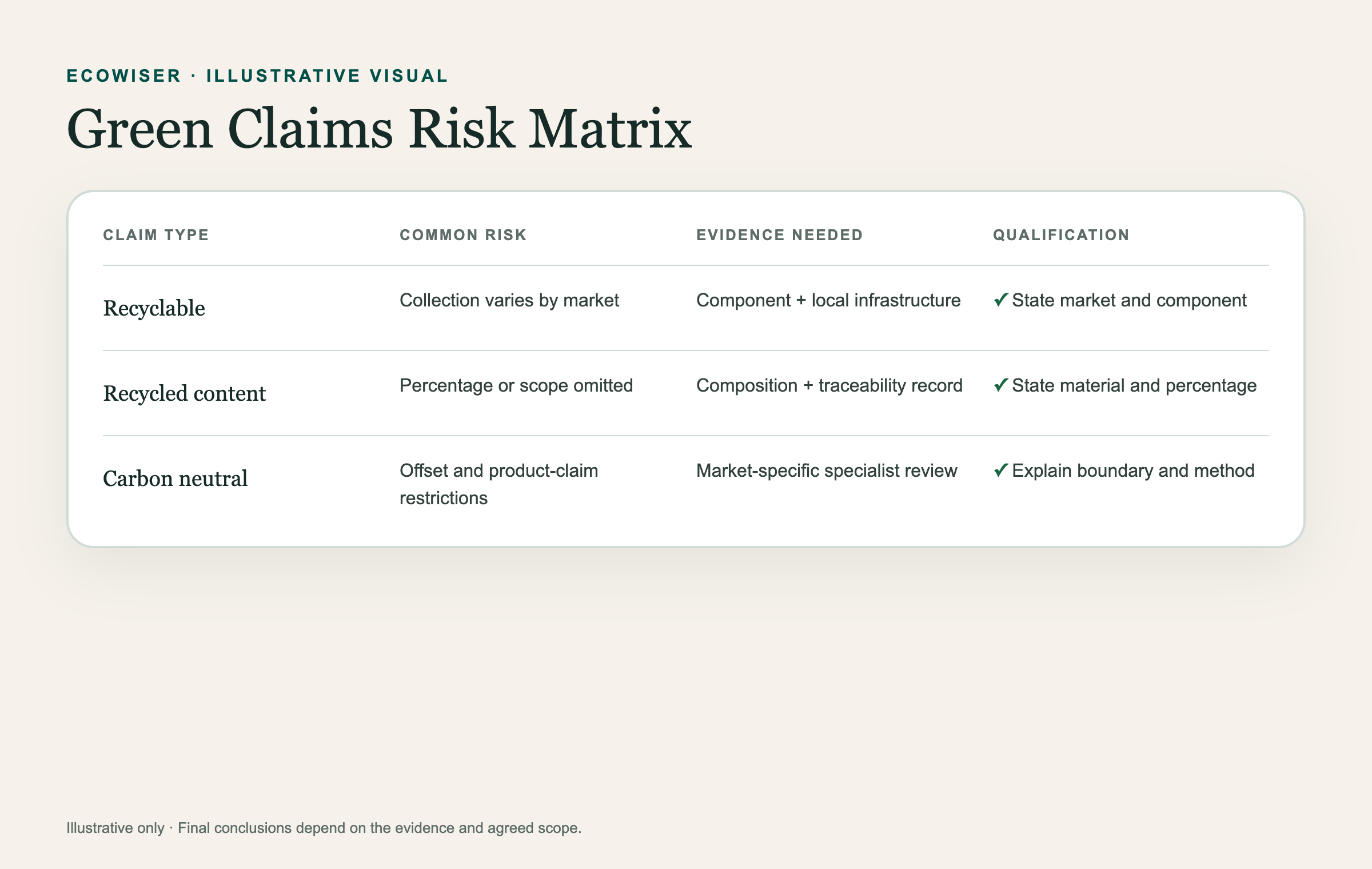
General guidance only. This does not determine legality or approve any claim.
Six evidence rules for every market.
- Be specific: define product, component, percentage, market and period.
- Hold evidence before publishing: do not publish first and substantiate later.
- Match wording to scope: packaging evidence cannot prove the whole product or company.
- Make qualifications visible: keep material limitations close to the claim.
- Test the whole impression: words, imagery, seals, colours and omissions all matter.
- Keep evidence current: review when products, suppliers, certificates, methods or law change.
European Union: rules apply from 27 September 2026.
Directive (EU) 2024/825 restricts unsupported generic environmental claims, sustainability labels not based on a qualifying certification scheme or public authority, product climate-impact claims based on offsetting, and unsupported future-performance claims.
A voluntary medal or status icon may be a sustainability label even if called something else. Ecowiser will not launch an EU-facing promotional Wiser medal until specialist review confirms the scheme structure and monitoring are suitable.
The separate Green Claims Directive proposal is not current binding law. Its legislative status is uncertain; Directive 2024/825 is the adopted measure addressed now.
United Kingdom.
The CMA Green Claims Code expects claims to be truthful and accurate, clear, free of material omissions, based on fair comparisons, lifecycle-aware where relevant and substantiated. The 2026 supply-chain guidance reinforces that businesses should check rather than blindly repeat supplier claims.
United States.
The FTC Green Guides and 16 CFR Part 260 remain the current federal guidance checked in August 2026. Identify reasonable interpretations, qualify broad claims, define whether the claim applies to product, packaging or component, and avoid unsupported certification impressions.
India.
India’s CCPA 2024 Greenwashing Guidelines address concealment, omission, exaggeration and vague or unsubstantiated claims. Terms including green, eco-friendly, natural, organic, sustainable, regenerative, cruelty-free and carbon-neutral require adequate, accurate and accessible qualification, substantiation and disclosure.
France.
DGCCRF guidance expects environmental claims to be reliable, unambiguous, verifiable, clear and precise. French Environmental Code Article L.229-68 and Decree 2022-539 impose specific public-substantiation conditions for carbon-neutral or equivalent advertising. Specialist review is required.
Common high-risk claims.
Sustainable / eco-friendly / green: often too broad without a nearby specific explanation.
Carbon neutral: requires market-specific treatment; EU product claims based on offsetting face prohibition from 27 September 2026.
Recyclable / biodegradable / compostable: define component, market, conditions and actual collection/processing.
Made with recycled material: state the material, percentage, method and whether it applies to product, packaging or one component.
Claims Audit process.
- Inventory live and planned claims.
- Map express and implied messages, scope, market and owner.
- Connect each claim to current evidence.
- Test clarity, qualification, lifecycle boundaries, comparisons and labels.
- Rewrite broad language into specific supportable wording.
- Assign internal and specialist sign-off.
- Monitor expiry, supplier changes, complaints and regulatory updates.
Make the claim no stronger than the evidence.
A Claims Audit identifies unsupported wording, missing qualifications and evidence gaps before a claim reaches customers, retailers or regulators.